
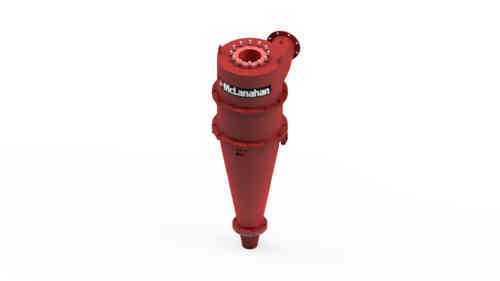
They can be used in industries such as sand, aggregates, coal, industrial minerals, hard rock mining and more. Hydrocyclones were invented in the late 1800s and became widely used in mineral processing because they are relatively inexpensive, process high volumes, take up minimal floor space and have no moving parts.
Hydrocyclones are exceptionally simple machines but require process knowledge to be utilized properly. Although there are many configurations, most Hydrocyclones have a cylindrical upper (feed) section, with either a tangential or involute style feed inlet, followed by lower conical sections ending with the apex. Designs that combine rubber-lined, bolt-together sections makes them simple to operate and maintain. Alternative linings, such as polyurethanes and ceramics, are also available.
- No moving parts
- Process high volumes
- Small footprint
- Simple to operate
- Capable of separating fine solids from liquid
- Rubber-lined standard; urethane and ceramic lining optional
- 4” to 36” (100mm to 900mm) sizes are available
- Multiple cone angles are available
- Strong process support and systems integration
